Payout Speed & Canadian Settlement Wire Benchmark
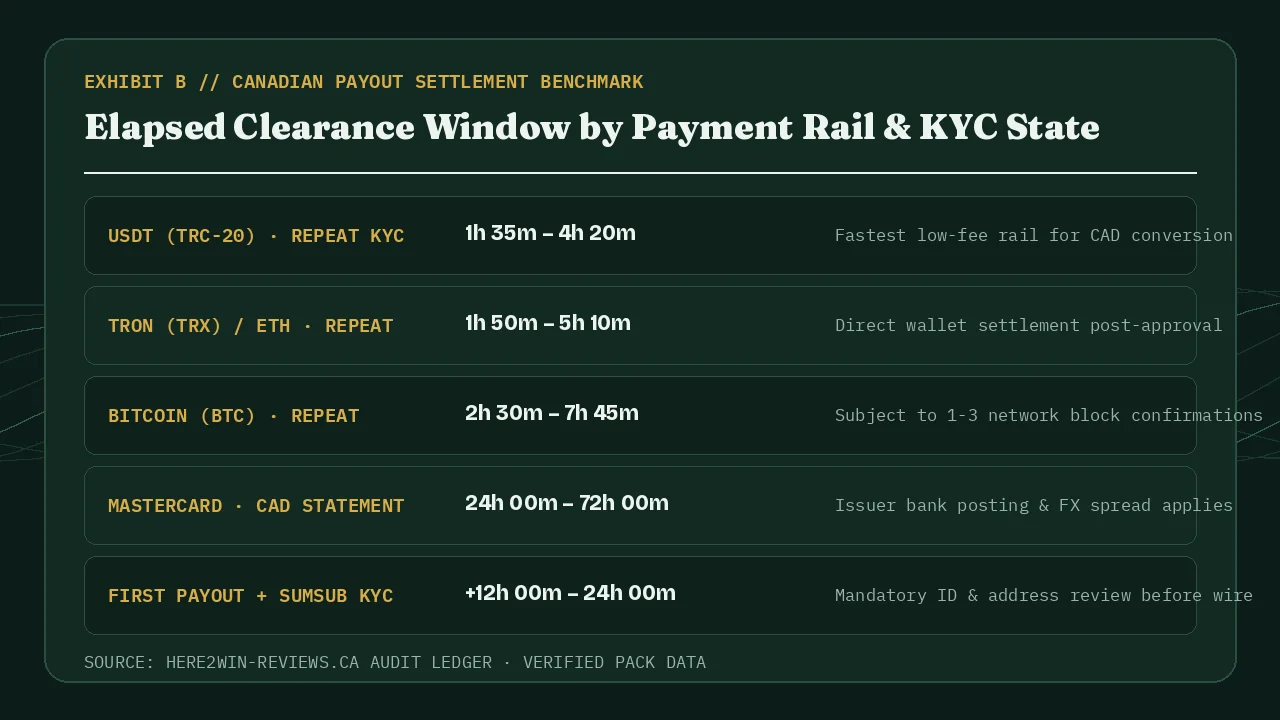
How long a withdrawal takes at Here2Win casino depends on two distinct clocks: one-time SumSub identity screening on your initial cash-out and the settlement speed of your chosen crypto or Mastercard rail. Use our interactive estimator below to calculate realistic arrival windows in CAD equivalents.
Canadian Settlement Window Estimator
Why First Withdrawals Take Longer Than Repeat Wires
Terms on file mandate identity verification through SumSub prior to the first withdrawal release. When a Canadian player requests an initial cash-out without pre-uploading documents, the payout enters a compliance queue until photo ID, selfie liveness, and 90-day address proof are approved — a stage we document step by step in our hands-on SumSub verification log and in Case #CA-204 on resolving a 19-hour address hold.
Once that verification badge is locked onto your account, subsequent withdrawals bypass manual ID inspection and route straight to treasury signing. In our side-by-side crypto versus Mastercard settlement comparison for Canada, USDT and TRX consistently delivered the lowest FX friction and fastest finality, whereas card payouts depend on Canadian issuing bank posting cycles of one to three business days.
High-Value Tranche Scheduling & Active Bonus Holds
Two additional rules govern payout timing on larger Canadian balances. First, cash-outs with uncompleted rollover cannot be dispatched until the x35 or x30 requirement hits 100%, and requesting an early withdrawal of locked funds risks forfeiting active bonus credits. Second, multi-thousand-dollar requests may be scheduled across consecutive daily tranches, as verified in Case #CA-191 on split-tranche cashout settlement.
Supported Canadian Cashier Rails & Settlement Notes
| Payment Method | Min Deposit | Repeat Payout Window | CAD Conversion & Compliance Notes |
|---|---|---|---|
| Tether (USDT) | US$15 (~C$21) | 1.6h – 4.3h | Pegged to USD; minimal spread when swapped to CAD on Canadian exchanges. |
| Tron (TRX) | US$15 (~C$21) | 1.8h – 4.8h | Fast block finality and sub-dollar network transfer cost. |
| Bitcoin (BTC) | US$15 (~C$21) | 2.5h – 7.5h | Reliable for larger tranches; arrival depends on mempool block confirmations. |
| Ethereum (ETH) | US$15 (~C$21) | 2.0h – 5.5h | Direct wallet dispatch; gas fee varies with network congestion. |
| Mastercard | US$15 (~C$21) | 24h – 72h | Convenient CAD card funding; some Canadian banks apply 1.8%–2.5% FX spread or cash-advance coding. |
Weekend Queue Cutoffs & Canadian Time Zone Effects
Understanding how operator treasury batches align with Canadian time zones eliminates unnecessary anxiety while a payout shows pending status. Internal cryptocurrency approvals operate seven days a week, meaning a verified player in Toronto (EST), Calgary (MST), or Vancouver (PST) who requests a USDT or TRX payout on Saturday afternoon still enters active signing queues without waiting for Monday morning banking reopenings.
Mastercard statement credits behave differently because final settlement depends on domestic card-acquiring networks and Canadian bank batch processing. Even if treasury releases a card payout within six hours on a Friday evening, major issuers across Ontario, Québec, and British Columbia typically post inbound merchant credits only after Monday night overnight clearing completes, extending wall-clock arrival toward the 48-to-72-hour mark.